



€111,95
- 130 mmAperture
- 650 mmFocal length
- f/5Focal ratio
- EquatorialRA drive mount
The Celestron AstroMaster 130 EQ-MD is a 130 mm Newton reflector telescope designed for beginner stargazers. Its large mirror and f/5 focal ratio make it suitable for both deep-sky objects and the Moon and planets. The telescope is mounted on an equatorial mount, which makes it easier to track objects as they move across the sky. The EQ-MD version also features a drive in the right ascension axis, which moves the telescope with the rotating sky.
130 mm
Aperture
650 mm
Focal length
f/5
Focal ratio
Equatorial
RA drive mount
EQ-MD or EQ? Both telescopes have identical optics – a 130 mm mirror, 650 mm focal length, f/5 – and 20 mm and 10 mm eyepieces. The difference is the drive: the AstroMaster 130 EQ-MD automatically tracks the observed object in the right ascension axis, so there is no need to manually adjust the settings constantly, making it easier to show the sky to others. If manual tracking with a knob is sufficient for you, choose the Celestron AstroMaster 130 EQ. The Celestron AstroMaster 70 AZ 70/900, on the other hand, is a lighter 70 mm refractor with a 900 mm focal length (f/13) on a simple alt-azimuth mount – better for daytime and planetary observations, but it collects significantly less light.
Key Features
- The 130 mm primary mirror collects approximately 345 times more light than the human eye – good for nebulae, clusters, and galaxies.
- The f/5 focal ratio and 650 mm focal length provide a wide field of view with long-focal-length eyepieces.
- Glass mirrors with aluminum and SiO₂ coatings, spherical primary mirror.
- CG-3 equatorial mount with setting circles and extendable tripod legs – once aligned with the celestial pole, only one axis needs to be moved to track an object.
- Right ascension axis drive included – compensates for the Earth's rotation and automatically tracks the observed object.
- StarPointer finder scope (red dot, no magnification) for quick aiming.
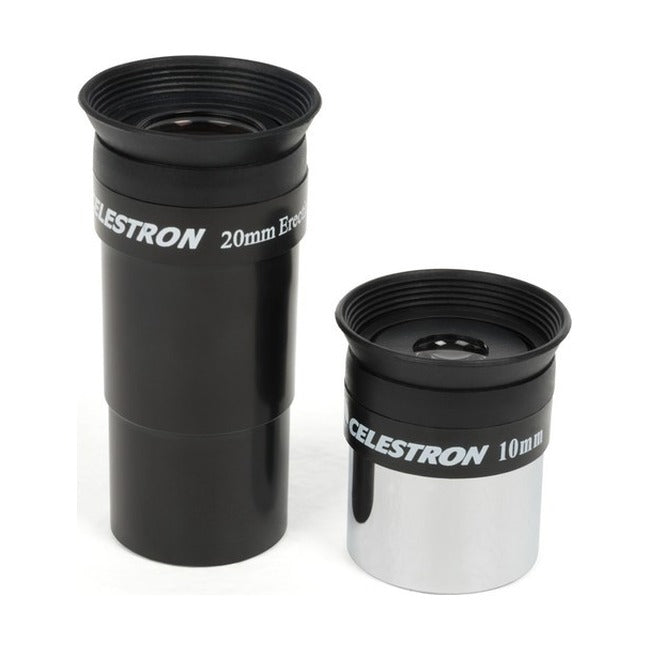
- 20 mm (erect image) and 10 mm eyepieces included – 32.5× and 65× magnification.
- Set weight 7.71 kg, tube 3.5 kg – easy to take the telescope by car to a darker location.
Applications
The telescope is designed for people starting astronomical observations. It clearly shows bright objects in the Solar System – craters on the Moon, Jupiter's bands and its four main moons, Saturn's rings, Venus's phases, or Mars's disk – and thanks to its 130 mm aperture, also star clusters, nebulae, and brighter galaxies. The short focal length allows for a wide field of view, and the low weight makes it easy to transport out of town.
Technical Specifications
| Manufacturer | Celestron |
|---|---|
| Model | AstroMaster 130 EQ-MD |
| Optical system | Newton reflector, spherical primary mirror |
| Aperture | 130 mm |
| Focal length | 650 mm |
| Focal ratio | f/5 |
| Mirror coating | aluminum and SiO₂ |
| Maximum useful magnification | 307× |
| Star magnitude | 13.1 mag |
| Resolving power (Rayleigh / Dawes) | 1.07″ / 0.89″ |
| Secondary mirror obstruction | 44 mm (34% of aperture) |
| Tube length | 552 mm |
| Tube diameter | 160.5 mm |
| Tube weight | 3.5 kg |
| Mount | CG-3 equatorial, steel tripod with extendable legs and shelf, RA drive |
| Finder | StarPointer (red dot, no magnification) |
| Set weight | 7.71 kg |
| Eyepieces included | 20 mm (erect image, 32.5×) and 10 mm (65×) |
| Manufacturer catalog number | 31051 |
| EAN | 050234310512 |
Package Contents
- 130/650 mm Newton optical tube
- Equatorial mount with tripod and right ascension axis drive (motor)
- 20 mm eyepiece (erect image) and 10 mm eyepiece
- StarPointer finder scope (red dot)
Frequently Asked Questions
Is the telescope suitable for planetary observations?
Yes. With the 10 mm eyepiece, you will get 65× magnification, which shows, among other things, the bands on Jupiter and its moons, as well as Saturn's rings. Higher magnifications can be obtained by purchasing a shorter eyepiece or a Barlow lens.
Can I observe the Sun?
Only with a suitable solar filter fitted to the tube inlet and in accordance with the filter manufacturer's instructions. Observing the Sun without a filter is dangerous for your eyes and equipment.
Do the mirrors need to be collimated?
Newton telescope mirrors require collimation from time to time. This can be done manually, and a collimator is helpful for this, e.g. the Baader Mark III Laser Collimator.
Compatible Accessories
Compatible with this model – add them to your cart without leaving the page.

€97,95


€267,95

€91,95