



€111,95
- 130 mmAperture
- 650 mmFocal length
- f/5Focal ratio
- EquatorialMount
The Celestron AstroMaster 130 EQ is a 130 mm Newton reflector telescope designed for beginner stargazers. Its large mirror and f/5 focal ratio make it suitable for both deep-sky objects and the Moon and planets. The telescope is mounted on an equatorial mount, which makes it easier to track objects as they move across the sky.
130 mm
Aperture
650 mm
Focal length
f/5
Focal ratio
Equatorial
Mount
EQ or EQ-MD? Both telescopes have identical optics – a 130 mm mirror, 650 mm focal length, f/5 – and 20 mm and 10 mm eyepieces. The difference is the drive: the AstroMaster 130 EQ is manually operated using the right ascension control knob, while the Celestron AstroMaster 130 EQ-MD has a motor that automatically tracks objects. If you want to observe more comfortably without manual tracking, choose the MD version. Alternatively, you could consider the Celestron AstroMaster 70 AZ 70/900 – a lighter 70 mm (f/13) refractor on an alt-azimuth mount, which is better for daytime observation but collects significantly less light than the 130 mm mirror.
Key Features
- The 130 mm primary mirror collects approximately 345 times more light than the human eye – ideal for nebulae, star clusters, and galaxies.
- The f/5 focal ratio and 650 mm focal length provide a wide field of view with longer focal length eyepieces.
- Glass mirrors with aluminum and SiO₂ coatings; spherical primary mirror.
- Manual CG-3 equatorial mount with graduated circles and extendable tripod legs – once polar aligned, you only need to move one axis to track an object.
- StarPointer finder scope (red dot, no magnification) for quick aiming.
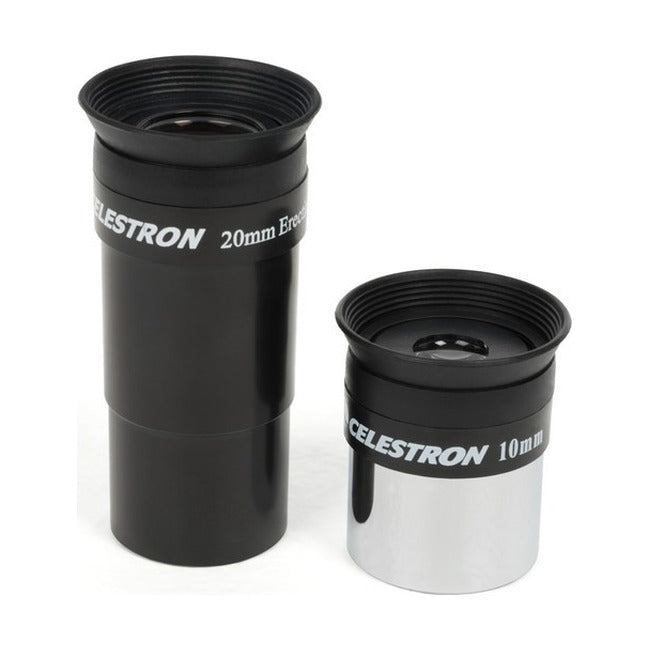
- Includes 20 mm (erect image) and 10 mm eyepieces – 32.5× and 65× magnification.
- The set weighs 7.71 kg, with the optical tube weighing 3.5 kg – easy to take the telescope by car to a darker location.
Applications
The telescope is designed for people starting out in astronomy. It clearly shows bright Solar System objects – craters on the Moon, Jupiter's bands and its four main moons, Saturn's rings, the phases of Venus, or the disk of Mars – and thanks to its 130 mm aperture, also star clusters, nebulae, and brighter galaxies. The short focal length provides a wide field of view, while the low weight makes it easy to transport out of town.
Technical Specifications
| Manufacturer | Celestron |
|---|---|
| Model | AstroMaster 130 EQ |
| Optical system | Newton reflector, spherical primary mirror |
| Aperture | 130 mm |
| Focal length | 650 mm |
| Focal ratio | f/5 |
| Mirror coating | aluminum and SiO₂ |
| Maximum useful magnification | 307× |
| Star magnitude | 13.1 mag |
| Resolving power (Rayleigh / Dawes) | 1.07″ / 0.89″ |
| Secondary mirror obstruction | 44 mm (34% of aperture) |
| Optical tube length | 552 mm |
| Optical tube diameter | 160.5 mm |
| Optical tube weight | 3.5 kg |
| Mount | CG-3 equatorial (manual), steel tripod with extendable legs and shelf |
| Finder | StarPointer (red dot, no magnification) |
| Set weight | 7.71 kg |
| Eyepieces included | 20 mm (erect image, 32.5×) and 10 mm (65×) |
| Manufacturer catalog number | 31045 |
| EAN | 050234310451 |
Package Contents
- 130/650 mm Newton optical tube
- Equatorial mount with tripod
- 20 mm eyepiece (erect image) and 10 mm eyepiece
- StarPointer finder scope (red dot)
Frequently Asked Questions
Is the telescope suitable for observing planets?
Yes. With the 10 mm eyepiece, you will get 65× magnification, which shows Jupiter's bands and its moons, as well as Saturn's rings. Higher magnifications can be achieved by purchasing a shorter eyepiece or a Barlow lens.
Can I observe the Sun?
Only with a suitable solar filter fitted to the front of the optical tube and according to the filter manufacturer's instructions. Observing the Sun without a filter is dangerous for your eyes and the equipment.
Do the mirrors need to be collimated?
Newton reflector mirrors need to be collimated from time to time. This can be done manually, and a collimator is helpful for this, such as the Baader Mark III Laser Collimator.
Compatible Accessories
Compatible with this model – add them to your cart without leaving the page.

€97,95


€267,95

€91,95