


- 36.5 mmOptical length
- 140°Rotation range
- T-2Threads on both sides
- 1.25″Guide camera mount
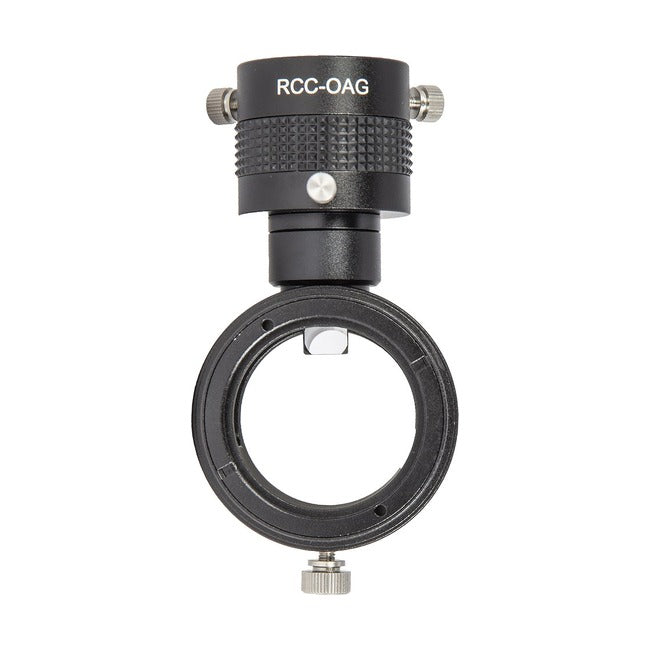
The Baader RCC-OAG Off-Axis Guider is an off-axis guide designed to work with the Baader RCC I coma corrector and DSLR cameras. A small prism reflects a portion of the light from the edge of the field to the guide camera or crosshair eyepiece. This allows the telescope to be guided during exposures without a separate guide scope.
36.5 mm
Optical length
140°
Rotation range
T-2
Threads on both sides
1.25″
Guide camera mount
Key Features
- Designed for the Baader RCC I coma corrector; the 36.5 mm optical length sets the correct distance to the camera sensor.
- Off-axis guiding for DSLRs using a T-Ring, without additional extension tubes.
- T-2 threads on both sides: female on the telescope side and male on the camera side.
- 1.25″ mount for a guide camera or crosshair eyepiece.
- 140° camera mount rotation without loosening the main connection.
- Radial and axial prism adjustment via knob, making it easy to center the guide star.
- The 9.35 mm wide prism enters the light path by approx. 6–7 mm, leaving approx. 31–32 mm of clear aperture.
Compatibility
The off-axis guider is designed for long-exposure astrophotography with a DSLR camera or camera. It allows the mount to be guided based on the image from the same telescope, eliminating the effects of flexure between the telescope and a separate guide scope.
Technical Specifications
| Manufacturer | Baader Planetarium |
|---|---|
| Model | RCC-OAG |
| Catalog number | 2956950 |
| Telescope-side connection | female T-2 thread (M42 x 0.75) |
| Camera-side connection | male T-2 thread |
| Guide camera mount | 1.25″ sleeve |
| Rotation range | 140° |
| Optical length | 36.5 mm |
| Prism width | 9.35 mm |
| Clear aperture | approx. 31–32 mm |
| Weight | 160 g |
| EAN | 4047825023506 |
Frequently Asked Questions
Is the guider only suitable for the RCC corrector?
It was designed for the RCC I coma corrector, but it has standard T-2 threads, so it can be combined with other T-2 accessories while maintaining the correct distance to the sensor.
Do I need a T-Ring?
Yes, to connect a DSLR, you need the appropriate T-Ring for the given mount.
Is a guide camera included?
No, the guider is a standalone accessory; the guide camera or crosshair eyepiece is purchased separately.