


- O-IIIOxygen line (496 and 501 nm)
- 6.5 nmBandwidth
- 1.25″Filter size
- 500 nmCenter wavelength
A 1.25″ narrowband O-III filter that highlights faint emission nebulae even in challenging urban conditions. A good choice for visual observers who want to significantly enhance nebula contrast.
O-III
Oxygen line (496 and 501 nm)
6.5 nm
Bandwidth
1.25″
Filter size
500 nm
Center wavelength
Key Features
- Transmits two emission lines of ionized oxygen and blocks most other light, including artificial lighting.
- Enhances the contrast of emission and planetary nebulae, such as the Veil (NGC 6992).
- The 1.25″ size is the eyepiece standard, so the filter is used with 1.25″ eyepieces and adapters.
- Anti-reflective interference coatings.
- Each filter has an individual test certificate with a transmission graph.
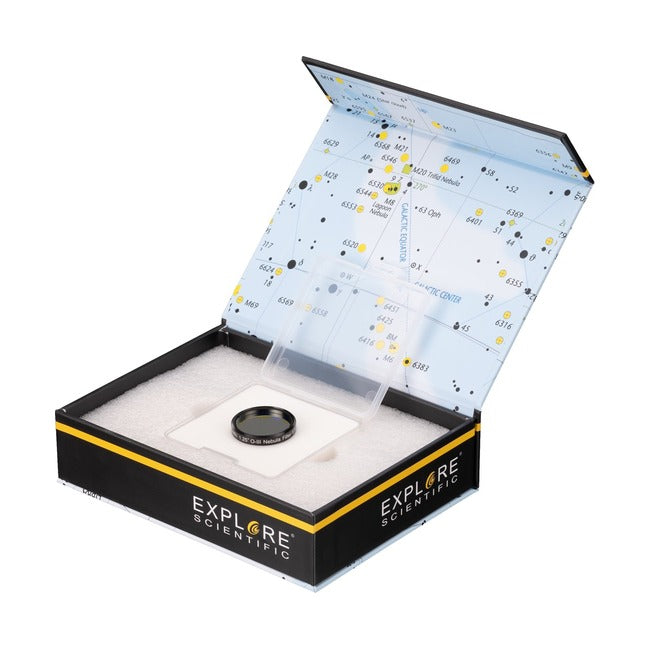
- Supplied in an elegant box with a magnetic closure.
Applications
The filter is designed for visual observation of nebular objects, especially in suburban and urban skies. It works best on emission and planetary nebulae that glow in the oxygen lines. It is not needed for stars, galaxies, and clusters, as it reduces their brightness.
Technical Specifications
| Manufacturer | Explore Scientific |
|---|---|
| Model | O-III 6.5 nm, 1.25″ nebula filter |
| Catalog Number | 0310105 |
| Filter Type | O-III narrowband |
| Size | 1.25″, filter in a frame |
| Center Wavelength (CWL) | 500 nm |
| Half Bandwidth (HBW) | 6.5 nm |
| Coatings | interference, anti-reflective |
| EAN | 4007922072661 |
Package Contents
- O-III 6.5 nm, 1.25″ filter
- Individual test certificate
- Box with magnetic closure
Frequently Asked Questions
Is the O-III filter suitable for all objects?
No. It improves the visibility of emission and planetary nebulae. It offers no benefits for galaxies and star clusters, as it reduces their brightness.
Is the filter useful under urban skies?
Yes, this is one of its main applications, as it blocks most artificial light. The effect depends on the object and the telescope's aperture.
Can this filter handle visual observations?
Yes, this is a filter for visual observation that increases the contrast of faint nebulae in an eyepiece.