


- Over 95%Light transmission
- 2″Filter size
- Neodymium glassSubstrate
- 23 + 7 layersCoatings
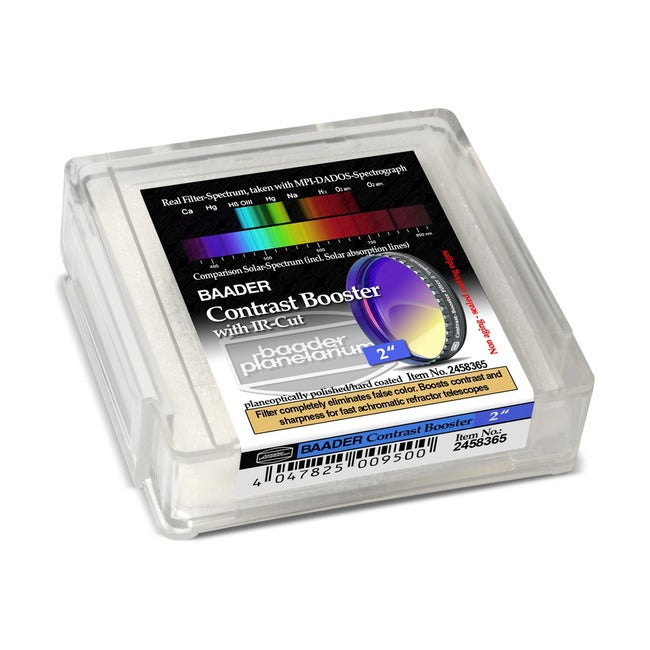
The Baader Contrast Booster 2" is a filter for achromatic refractors that almost completely eliminates the blue halo around bright objects. Details of the Moon and planets, especially Jupiter and Mars, become clearer. The image takes on a yellowish tint, similar to that of minus-violet filters, but with better contrast and sharpness.
Over 95%
Light transmission
2″
Filter size
Neodymium glass
Substrate
23 + 7 layers
Coatings
Key Features
- Almost completely blocks short-wavelength light below around 450 nm.
- Reduces chromatic aberration in achromatic refractors.
- Increases contrast and detail reproduction on the Moon and planets, including Jupiter.
- Light transmission over 95%.
- Neodymium glass, which also suppresses scattered light (skyglow).
- Front coating: 23-layer dielectric, rear: 7-layer anti-reflective.
- Hard coatings on both sides, resistant to scratches and frequent cleaning.
- Blocks infrared light, which would blur the image in digital photography.
Application
The filter is intended primarily for visual observation and photography of the Moon and planets through achromatic refractors. The manufacturer recommends it for telescopes with an aperture of 5″ (around 130 mm) and larger. In digital photography, the filter's tint can be largely corrected with white balance.
Technical Specifications
| Manufacturer | Baader Planetarium |
|---|---|
| Model | Contrast Booster 2" (cat. no. 2458365) |
| Type | contrast filter for achromatic refractors |
| Size | 2" (filter thread) |
| Substrate | neodymium glass |
| Front coating | 23-layer, dielectric |
| Rear coating | 7-layer, anti-reflective |
| Transmission | over 95% |
| Weight | 0.1 kg (shipping weight) |
| EAN | 4047825009500 |
Package Contents
- Baader Contrast Booster 2" filter
Frequently Asked Questions
Does it replace a Moon filter?
It improves the contrast and color of the lunar disc, so it can serve a similar purpose when observing the Moon.
Which telescopes is it intended for?
For achromatic refractors. The manufacturer recommends it from around 130 mm aperture; for smaller ones, it suggests the Fringe-Killer.
Does it darken the image?
Transmission exceeds 95%, but the image has a yellowish tint that becomes less noticeable after a while of observation.