

- ≤ 15 nmBandwidth
- 511 and 514 nmTransmitted C2 lines
- 2″Filter diameter
- Reflex-Blocker™Anti-halo coatings
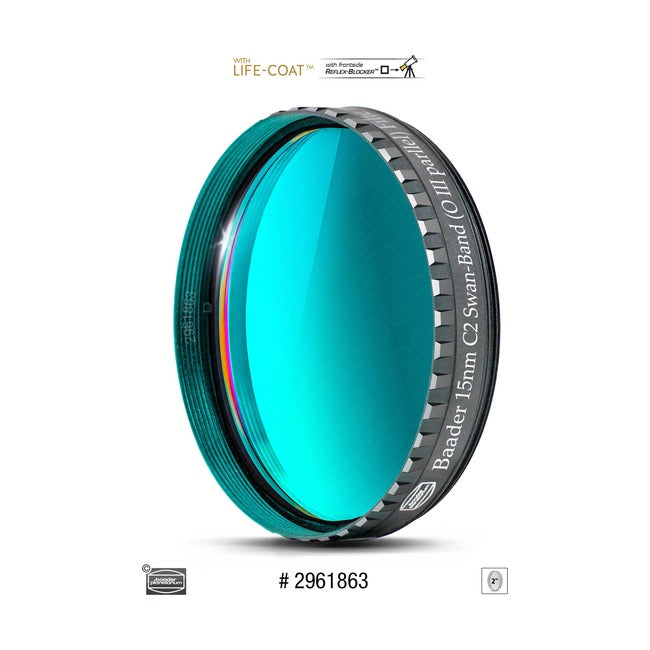
The Baader C2 Swan-Band is a narrow-band filter for comet hunters. It transmits two emission lines of diatomic carbon (C2) at 511 and 514 nm, which dominate the visible gas tail of a comet, while suppressing background scattered light. This makes structures in the gas tail clearer, even under good skies. The CMOS-optimized filter has a 2″ thread and screws into eyepieces or adapters.
≤ 15 nm
Bandwidth
511 and 514 nm
Transmitted C2 lines
2″
Filter diameter
Reflex-Blocker™
Anti-halo coatings
Key Features
- Isolates two C2 emission lines at 511 and 514 nm – dominant in the gas tail of a comet.
- The ≤ 15 nm band blocks scattered light, similar to a nebula filter when observing deep-sky objects.
- Completely blocks the O-III line at 501 nm and below, which is transmitted by other Swan-Band filters – resulting in higher contrast.
- Makes it easier to distinguish comets with a gas tail from those with a dominant dust tail (improvement is minor for dust tails).
- CMOS-optimized series: contrast optimized for the typical quantum efficiency of CMOS sensors.
- Reflex-Blocker™ coatings reduce halos around bright stars.
- Life-Coat™ coatings are highly durable, and each filter is coated individually with a sealed edge.
- Black edges and markings indicating the filter side facing the telescope reduce reflections; uniform filter thickness ensures parafocality.
Application
The filter is designed for visual observation and photography of comets with a distinct gas tail, even from locations with brighter skies and a nearly full moon. It helps reveal the full size of the ionized carbon cloud around the comet's head. It can be used with an eyepiece or camera, depending on where it is screwed in.
Technical Specifications
| Manufacturer | Baader Planetarium |
|---|---|
| Model | C2 Swan-Band 2″ (15 nm) – O-III parallel |
| Catalog Number | 2961863 |
| Bandwidth | ≤ 15 nm |
| Transmitted Lines | C2: 511 and 514 nm |
| Blocking | O-III line 501 nm and below |
| Mount Diameter | 2″ (filter thread) |
| Coatings | Reflex-Blocker™, Life-Coat™ |
| EAN | 4047825054135 |
Frequently Asked Questions
Is the filter suitable for observing nebulae?
It is not designed for this. It transmits the C2 carbon bands of comets; for nebulae, choose an O-III or UHC filter.
Does it improve the visibility of every comet?
It works best with comets that have a gas tail. For dust tails, the contrast improvement is only minor.
Which side of the filter should face the telescope?
The side with the black outer edge, which indicates the side facing the telescope.