


- 406 mmPyrex Mirror
- 1800 mmFocal Length (f/4.4)
- Go-ToSynScan and Wi-Fi
- Flex TubeCollapsible Tube
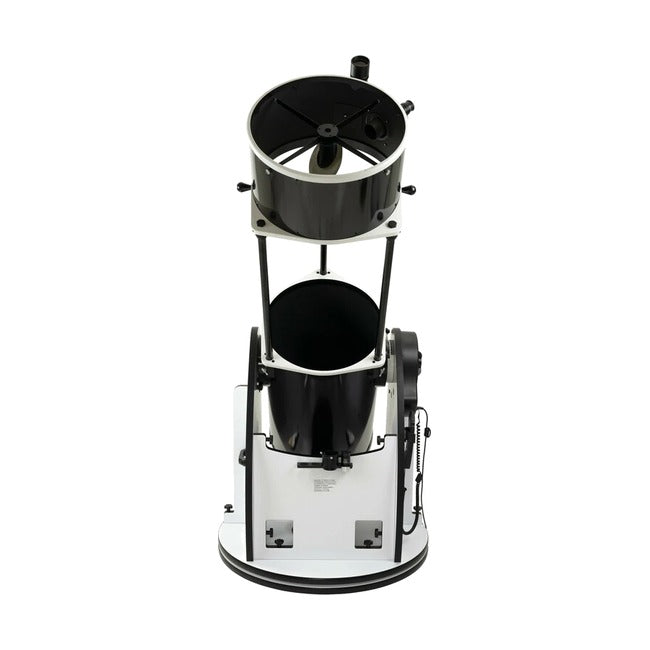
The Sky-Watcher Dobson 16″ Flex Tube Go-To is a large Newton telescope with parabolic optics and a 406 mm aperture, mounted on a Dobson mount with a Go-To system. Stepper motors automatically point the tube at thousands of objects and track their movement across the sky, while the collapsible Flex Tube allows the telescope to be folded down for transport and storage. This is an instrument for advanced observers who want to view nebulae, galaxies, and star clusters in all their glory.
406 mm
Pyrex Mirror
1800 mm
Focal Length (f/4.4)
Go-To
SynScan and Wi-Fi
Flex Tube
Collapsible Tube
Key Features
- 406 mm parabolic Pyrex primary mirror, coated with aluminum and protected by an oxidation- and scratch-resistant quartz coating.
- 1800 mm focal length and f/4.4 focal ratio – a bright image at low magnifications and a wide field of view.
- Ribbed conical mirror: lower mass, faster cooling, and no complicated cell with floating support points.
- The large secondary mirror provides 100% illumination for a wide field of view, e.g., with a 31 mm Nagler eyepiece.
- Go-To system: stepper motors, automatic locating of thousands of objects, and two-axis tracking.
- Dual axis encoders – the telescope can be moved manually without losing orientation.
- Control via SynScan controller or through the built-in Wi-Fi module and the free SynScan Pro app (Google Play, App Store).
- Collapsible Flex Tube design – no tools or tube disassembly required, and no need to collimate after every setup.
- 2″ Crayford focuser with microfocuser and 1.25″ reducer, compatible with Sky-Watcher autofocus drives.
Applications
The large 40 cm aperture means that the telescope is usually limited only by atmospheric stability, not by optical capabilities. Under dark skies, it reveals the delicate structure of emission nebulae, resolves globular clusters into thousands of stars, and unveils the spiral arms of galaxies, as well as hundreds of objects from the Caldwell, Herschel, Abell, and Sharpless catalogs. The high resolution also allows for detailed observations of the Moon and planets: Jupiter's bands, the Great Red Spot, Saturn's rings with the Cassini division, and changes on the surface of Mars. The Go-To system is also useful for simple planetary photography and short-exposure imaging after equipping it with a camera or DSLR. With such bright optics, it is worth using high-quality eyepieces, a coma corrector, and nebula filters (UHC, OIII, H-beta).
Technical Specifications
| Manufacturer | Sky-Watcher |
|---|---|
| Model | Dobson 16″ Flex Tube Go-To |
| Optical System | Newtonian, parabolic Pyrex mirror |
| Primary Mirror Diameter | 406 mm (16″) |
| Focal Length | 1800 mm |
| Focal Ratio | f/4.4 |
| Mirror Coatings | Aluminum with quartz protection |
| Eyepiece Focuser | 2″ Crayford with microfocuser, 1.25″ reducer |
| Mount | Dobson (alt-azimuthal) with Go-To, stepper motors, dual encoders |
| Control | SynScan controller or Wi-Fi and SynScan Pro app |
| Power Supply | Car socket power supply included; mains power supply sold separately |
| EAN | 5901691603585 |
Package Contents
- 406/1800 mm Flex Tube Newtonian tube
- Primary mirror in cell (delivered in a separate box)
- Dobson mount with Go-To system
- SynScan hand controller with Wi-Fi module
- 2″ Crayford focuser with 2″ extension and 1.25″ extension/reducer
- Car socket power supply
Frequently Asked Questions
Does the telescope come with a mains power supply?
No. The package only includes a car socket power supply; the mains power supply must be purchased separately.
Why is the primary mirror in a separate box?
For safety and due to its size, the mirror is delivered separately. The manufacturer mounts it in a cell prepared for installation in the tube.
Can I observe the Sun?
Only with a certified solar filter fitted to the front of the tube. Never point the telescope at the Sun without a filter – this can cause permanent eye damage. When using solar filters on the Flex Tube, a light shield must always be used to prevent light from entering the side of the tube.